
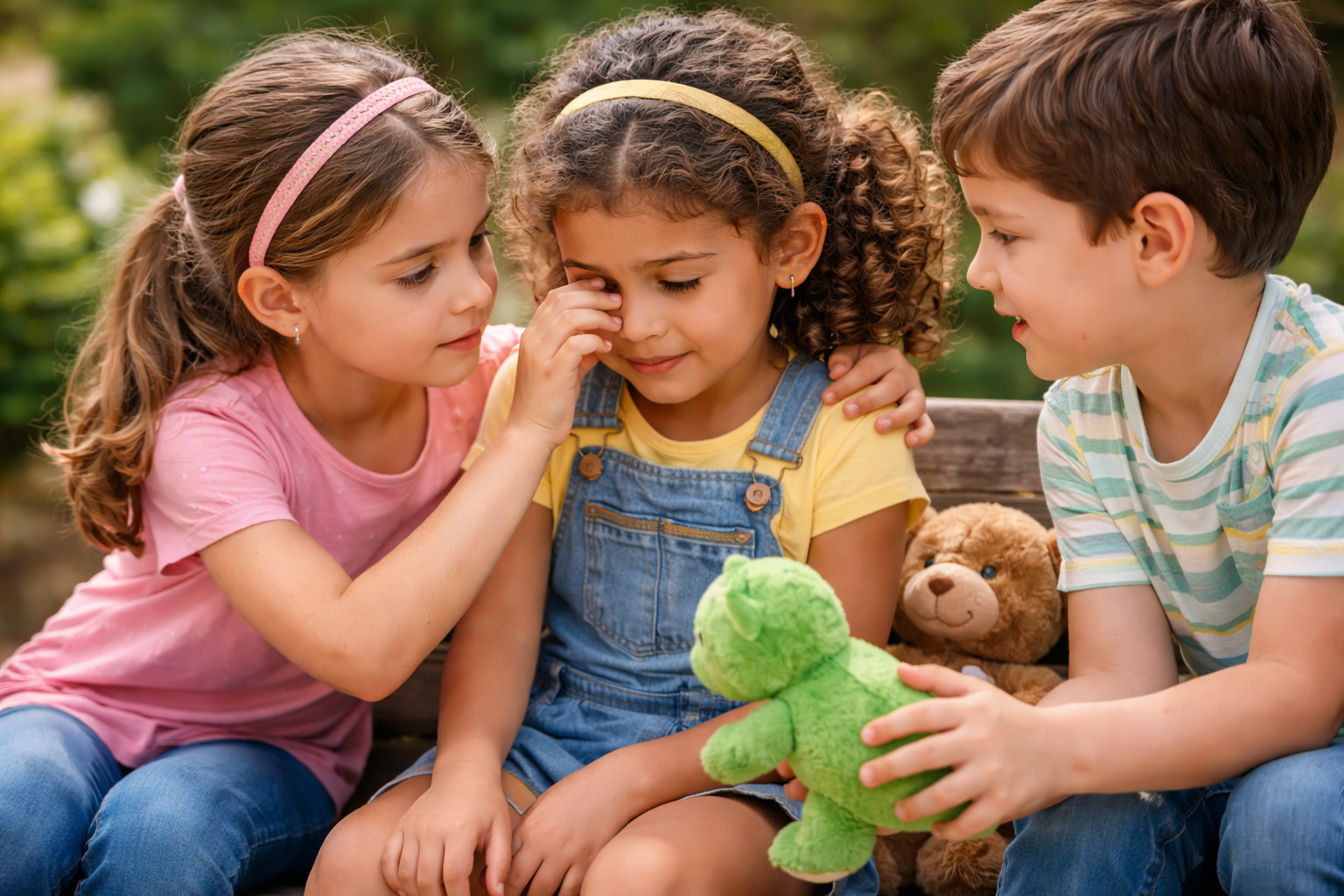
Empathy is one of the most powerful skills a child can develop. It is the ability to understand and share the feelings of others — to recognize when someone is hurt, sad, happy, or in need of support.
Children are not born with fully developed empathy. While they may show early signs of emotional sensitivity, true empathy grows gradually through guidance, modeling, and meaningful social experiences.
When nurtured intentionally, empathy strengthens relationships, reduces conflicts, and helps children grow into kind, responsible adults. Let’s explore how empathy develops in childhood and how parents can actively support it.
What Is Empathy?
Empathy goes beyond simple kindness. It involves three main components:
- Emotional recognition — Identifying how someone else feels
- Perspective-taking — Understanding another person’s point of view
- Compassionate response — Taking action to help or comfort
For young children, empathy often begins with noticing emotions. Over time, it becomes more complex and intentional.
How Empathy Develops by Age
Empathy evolves gradually as children’s brains mature and their social experiences expand.
Infants (0–12 Months)
Babies may cry when they hear another baby crying. This is called emotional contagion — an early form of empathy.
At this stage, babies:
- Respond to facial expressions
- React to tone of voice
- Seek comfort when distressed
While they cannot yet understand others’ emotions fully, they are sensitive to emotional energy.
Toddlers (1–3 Years)
Toddlers begin recognizing basic emotions in others.
They may:
- Offer a toy to someone who is upset
- Pat someone who is crying
- Show concern when a caregiver appears sad
However, their empathy is still limited by egocentric thinking. They often assume others feel the same way they do.
Gentle guidance helps expand their awareness.
Preschoolers (3–5 Years)
During this stage, perspective-taking improves.
Children begin to:
- Understand that others can feel differently
- Recognize more complex emotions
- Express concern verbally
- Attempt to comfort intentionally
Imaginative play plays a major role in empathy development at this age.
School-Age Children (6+ Years)
Empathy becomes more sophisticated.
Children can:
- Consider multiple viewpoints
- Understand fairness and justice
- Show compassion beyond immediate family
- Respond thoughtfully to emotional situations
Peer relationships now become important learning environments for empathy.
Why Empathy Matters
Children who develop strong empathy tend to:
- Build healthier friendships
- Resolve conflicts more peacefully
- Show lower levels of aggression
- Demonstrate leadership qualities
- Develop stronger emotional intelligence
Empathy supports not only social success but also emotional well-being.
It strengthens connection, trust, and cooperation.
Model Empathy in Everyday Life
Children learn empathy primarily by observing adults.
If you respond with patience, understanding, and compassion, your child absorbs those behaviors.
For example:
- “That person seems upset. I wonder what happened.”
- “Your friend looked sad when that happened. Let’s check on them.”
- “I understand why you feel disappointed.”
When children see empathy in action, they learn how to apply it themselves.
Modeling remains the most powerful teaching tool.
Label Emotions Clearly
Children cannot respond empathetically if they do not recognize emotions.
Use everyday situations to label feelings:
- “She looks frustrated.”
- “He seems excited.”
- “You look disappointed.”
Books and storytelling are also excellent tools for emotional discussions.
Ask questions such as:
- “How do you think the character feels?”
- “Why do you think that happened?”
This strengthens emotional awareness.
Encourage Perspective-Taking
Perspective-taking helps children understand that others have different thoughts and feelings.
You can encourage this by asking:
- “How would you feel if that happened to you?”
- “Why do you think your friend reacted that way?”
- “What could we do to help?”
These questions promote reflection and emotional growth.
Over time, children begin asking themselves these questions internally.
Teach Problem-Solving with Compassion
When conflicts arise, guide children toward empathetic solutions.
Instead of assigning blame, try:
- “What happened?”
- “How did each person feel?”
- “How can we fix this?”
Encourage children to take responsibility and repair relationships.
Apologizing, offering help, or finding compromise are valuable empathy-building moments.
Use Pretend Play to Strengthen Empathy
Role-playing different situations allows children to practice understanding others.
Pretend scenarios such as:
- Playing doctor
- Acting out family situations
- Running a pretend store
- Caring for dolls or stuffed animals
help children imagine different perspectives.
Imaginative play strengthens emotional flexibility and understanding.
Reinforce Acts of Kindness
When your child shows empathy, acknowledge it specifically.
Instead of saying:
- “Good job.”
Try:
- “I noticed you shared your toy when your friend was sad. That was thoughtful.”
- “You helped your sibling when they were struggling. That was kind.”
Specific praise reinforces compassionate behavior.
Avoid Dismissing Emotions
If children hear:
- “It’s not a big deal.”
- “Stop crying.”
- “You’re being dramatic.”
they may learn to suppress emotions — both their own and others’.
Validation is key.
Even if the situation seems small, acknowledge feelings first. Emotional safety encourages empathy.
Teach Empathy Through Community Experiences
Community involvement can strengthen empathy.
Activities like:
- Volunteering as a family
- Helping neighbors
- Participating in donation drives
- Writing thank-you notes
expose children to diverse experiences and needs.
Real-world compassion deepens emotional understanding.
Managing Aggression and Self-Centered Behavior
It’s important to remember that empathy does not eliminate selfish behavior immediately.
Young children are still learning impulse control and emotional regulation.
Instead of punishment alone, use teaching moments:
- “When you grabbed the toy, your friend felt hurt.”
- “What can we do differently next time?”
Consistent guidance builds emotional maturity over time.
The Long-Term Impact of Empathy
Empathy influences not only childhood relationships but also adult success.
Empathetic individuals often:
- Communicate effectively
- Lead with compassion
- Handle conflict maturely
- Build strong personal and professional relationships
Empathy supports emotional resilience and social stability.
It is a lifelong asset.
Raising Compassionate Human Beings
Empathy does not develop overnight. It grows through everyday conversations, modeling, guidance, and emotional validation.
By helping your child recognize emotions, understand perspectives, and respond with compassion, you are shaping more than behavior — you are shaping character.
Small daily actions — comforting a friend, listening attentively, sharing generously — build a foundation for a caring and emotionally intelligent adult.
Every moment of guidance plants a seed of kindness.
And those seeds, nurtured consistently, grow into lifelong compassion.