
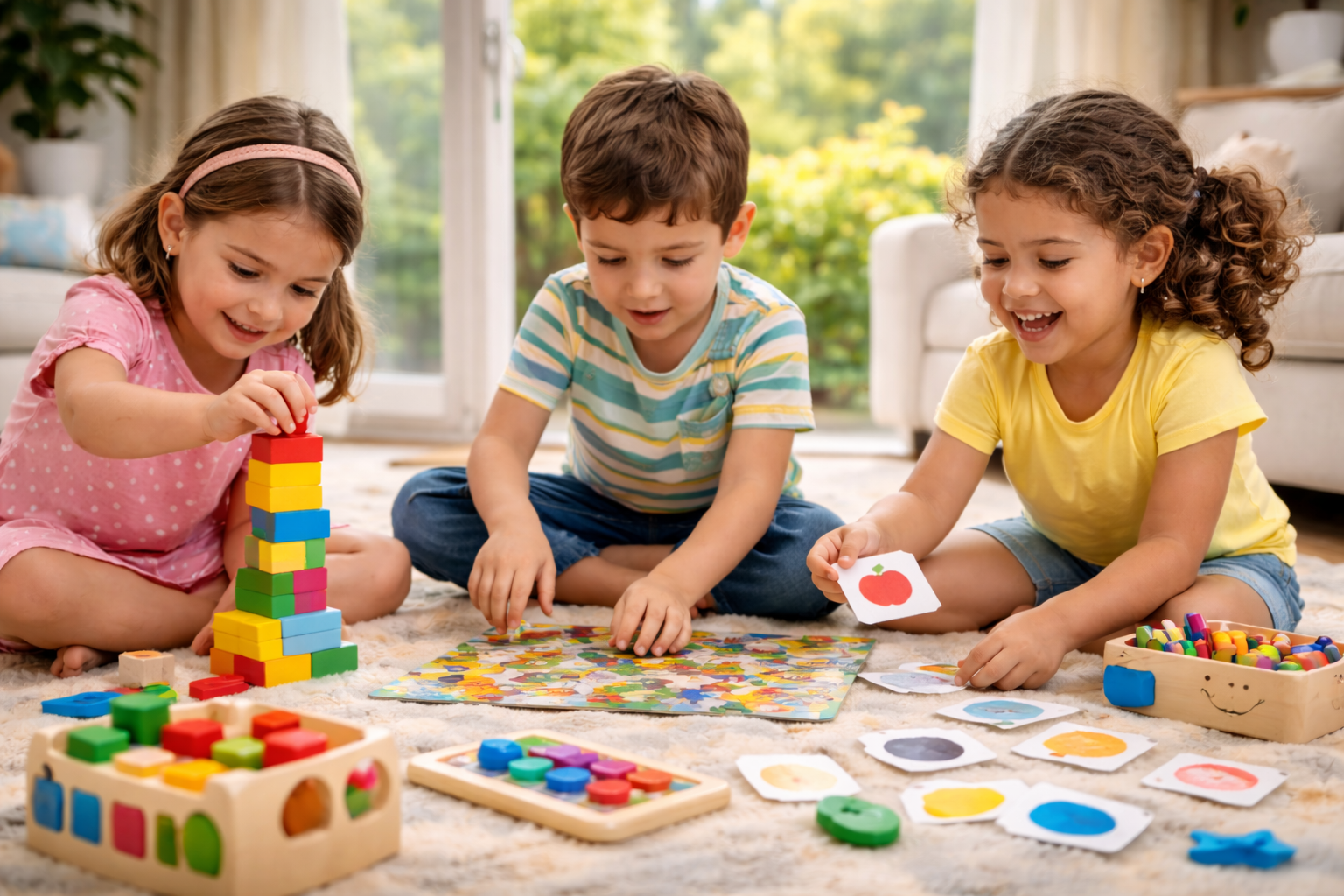
Play is often seen as simple fun — a way to pass time or release energy. But for children, play is much more than entertainment. It is one of the most powerful tools for cognitive development.
Through play, children learn to think, solve problems, remember information, focus attention, and make decisions. Every block they stack, every pretend story they create, and every puzzle they complete is shaping their brain in meaningful ways.
Understanding which types of play stimulate cognitive growth allows parents to create enriching experiences naturally — without pressure or over-structuring childhood.
What Is Cognitive Development?
Cognitive development refers to how children think, explore, remember, and understand the world around them. It includes skills such as:
- Attention and concentration
- Memory
- Problem-solving
- Logical thinking
- Language processing
- Creativity
- Decision-making
These skills form the foundation for academic learning and everyday functioning.
The good news is that cognitive development thrives in playful environments.
Why Play Is Essential for Brain Growth
During childhood, the brain forms connections rapidly. Each playful interaction strengthens neural pathways.
When children experiment, imagine, test ideas, and even make mistakes during play, they are building critical thinking skills.
Unlike passive activities, active play requires engagement. Engagement fuels learning.
The goal is not to “train” children academically at an early age — it is to provide meaningful experiences that stimulate curiosity.
Building Blocks and Construction Play
Simple building toys offer powerful cognitive benefits.
When children play with blocks, magnetic tiles, or stacking toys, they practice:
- Spatial awareness
- Planning and sequencing
- Cause and effect
- Problem-solving
For example, if a tower falls, a child must think about balance and structure to rebuild it successfully.
How to Encourage
- Ask open-ended questions: “What could make it stronger?”
- Allow experimentation without correcting immediately
- Celebrate creative designs
Construction play strengthens both logic and creativity.
Puzzles and Problem-Solving Games
Puzzles challenge children to think critically and persist through difficulty.
They promote:
- Visual recognition
- Memory skills
- Patience
- Logical reasoning
Even simple shape sorters for toddlers stimulate early problem-solving skills.
As children grow, more complex puzzles increase attention span and concentration.
The key is choosing age-appropriate challenges — difficult enough to stimulate thinking, but not so hard that frustration overwhelms motivation.
Pretend Play and Imagination
Imaginative play is one of the most powerful forms of cognitive stimulation.
When children pretend to run a store, cook a meal, or act as superheroes, they are:
- Practicing symbolic thinking
- Strengthening language skills
- Developing planning abilities
- Understanding social roles
Pretend scenarios require memory, creativity, and flexible thinking.
Encourage pretend play by providing simple props such as:
- Toy kitchen tools
- Dress-up clothes
- Play money
- Dolls or action figures
The simpler the toy, the more room there is for imagination.
Memory Games
Memory skills are central to cognitive development.
Activities like:
- Matching card games
- “I Spy”
- Repeating patterns
- Remembering short sequences
help strengthen working memory.
Memory games also improve attention and focus, which directly impact academic readiness later on.
You can easily integrate memory challenges into daily routines by asking:
- “Do you remember what we bought at the store?”
- “What did we read about yesterday?”
Everyday conversations can support brain development.
Board Games and Turn-Taking
Board games teach much more than following rules.
They support:
- Strategic thinking
- Planning ahead
- Patience
- Emotional regulation
- Flexible thinking
Children learn to anticipate outcomes and adjust strategies based on new information.
Even simple games that involve rolling dice or matching colors help develop counting and logical reasoning skills.
Most importantly, board games teach children how to handle winning and losing constructively.
Outdoor Play and Exploration
Cognitive development does not only happen indoors.
Outdoor exploration encourages:
- Observation skills
- Curiosity
- Questioning
- Scientific thinking
When a child asks, “Why do leaves fall?” or “How do ants carry food?” they are practicing inquiry-based learning.
Nature walks, scavenger hunts, and simple experiments (like observing how water flows) stimulate critical thinking naturally.
Exploration builds problem-solving abilities in real-world contexts.
Art and Creative Expression
Drawing, painting, sculpting, and crafting all support cognitive growth.
Creative activities enhance:
- Planning
- Decision-making
- Pattern recognition
- Fine motor coordination
- Abstract thinking
When a child chooses colors, decides where to place shapes, or invents a design, they are engaging higher-level thinking skills.
Encourage creativity without focusing on perfection. The process matters more than the result.
Music and Rhythm Activities
Music strengthens memory, pattern recognition, and auditory processing.
Singing songs with repetition improves language development and recall.
Clapping rhythms or playing simple instruments teaches sequencing and attention control.
Music also enhances listening skills — a key component of cognitive growth.
Simple Science Experiments
Hands-on experiments stimulate curiosity and logical reasoning.
Activities such as:
- Mixing colors
- Growing plants
- Observing melting ice
- Testing which objects float
teach cause and effect relationships.
Encourage children to make predictions before testing outcomes. This builds hypothesis-forming skills — a foundation of scientific thinking.
Limiting Passive Screen Time
While some educational programs may offer benefits, passive screen time does not provide the same level of cognitive stimulation as active play.
Children learn best through interaction, exploration, and conversation.
When screens replace hands-on experiences, opportunities for deep thinking decrease.
Balance is essential.
The Role of Parents in Cognitive Play
Parents do not need to lead every activity. In fact, independent play strengthens problem-solving skills.
However, involvement can deepen learning.
You can:
- Ask open-ended questions
- Encourage reflection
- Provide new challenges
- Offer emotional support during difficulty
Avoid taking control of the play. Guidance should empower, not dominate.
Creating a Stimulating Environment at Home
You do not need expensive materials to support cognitive development.
Provide:
- Open-ended toys
- Books
- Art supplies
- Safe outdoor time
- Opportunities for imaginative play
Rotate toys occasionally to maintain interest and curiosity.
Most importantly, create space for boredom. Boredom often sparks creativity.
Supporting Lifelong Thinking Skills
Cognitive development in early childhood lays the foundation for future academic achievement, emotional regulation, and decision-making.
The most powerful learning moments often happen during simple play.
By encouraging puzzles, imaginative games, building activities, creative expression, and exploration, you nurture curiosity and confidence.
Play is not a distraction from learning.
Play is learning.
Every moment spent exploring, imagining, and problem-solving strengthens your child’s mind in ways that last a lifetime.