
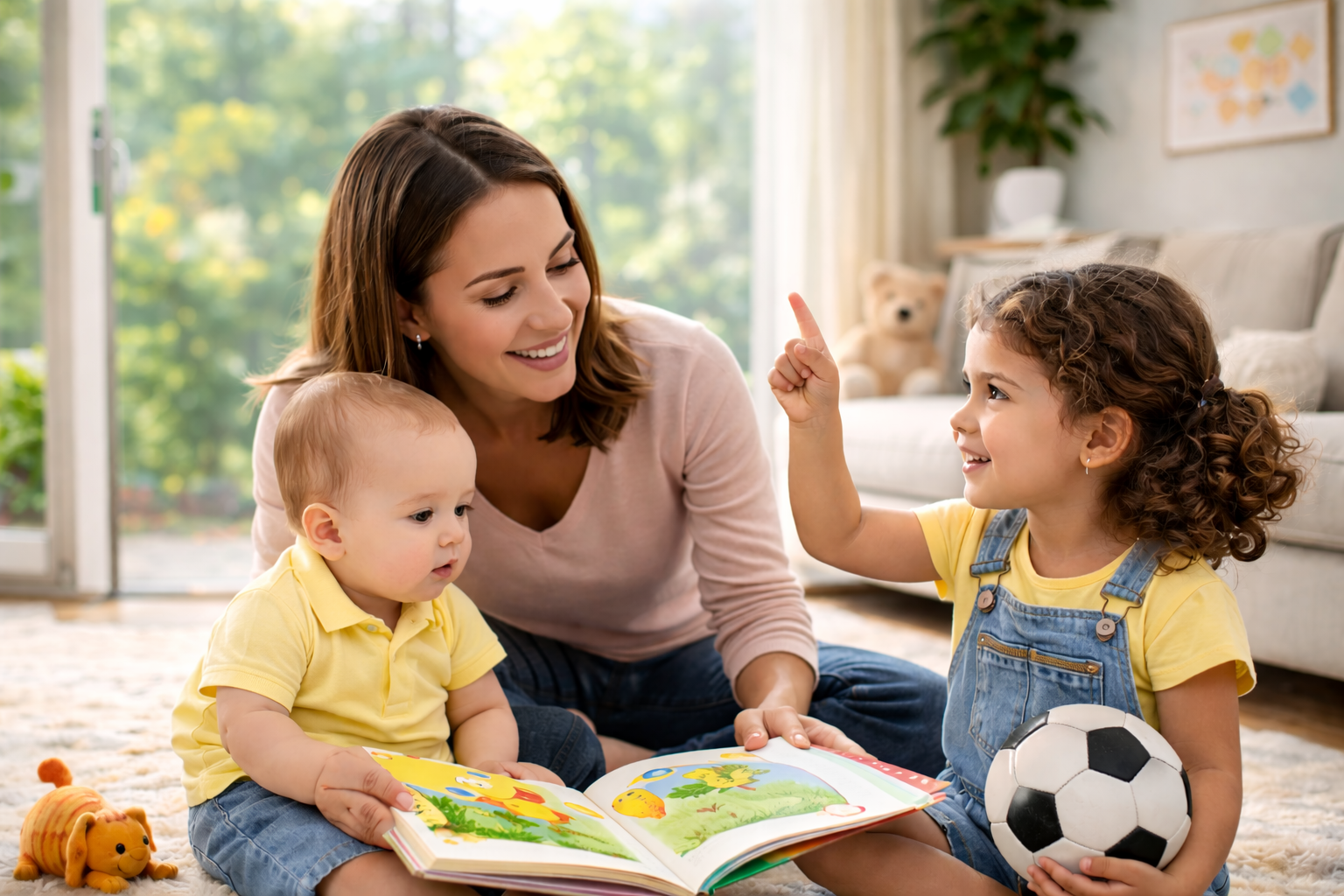
One of the most exciting parts of parenting is hearing your child’s first sounds, first words, and eventually, full sentences. Language development is a remarkable journey that begins long before a baby says “mama” or “dada.”
From birth, children are absorbing sounds, facial expressions, tone, and rhythm. Understanding what to expect month by month helps parents support communication naturally — without pressure or unrealistic comparisons.
Every child develops at their own pace, but knowing typical milestones can give you confidence and clarity as you guide your child through this important stage.
Birth to 2 Months: Communication Begins with Sound
Even newborns communicate — just not with words.
At this stage, babies:
- Cry to express needs
- Make reflexive sounds
- React to familiar voices
- Calm down when hearing caregivers
Crying is a baby’s first form of language. It may sound simple, but over time, parents often begin to distinguish between different types of cries — hunger, discomfort, or tiredness.
How to Support
- Talk to your baby throughout the day
- Maintain eye contact
- Use a warm and expressive tone
- Respond consistently to cries
This builds trust and early communication patterns.
2 to 4 Months: Cooing and Early Social Sounds
Around this time, babies begin making vowel-like sounds such as “oo” and “ah.” This stage is known as cooing.
You may notice:
- Smiling during interaction
- Responding to voices with excitement
- Attempting to mimic sounds
- Increased vocal play
Babies begin to understand the rhythm of conversation — taking turns making sounds with you.
How to Support
- Imitate your baby’s sounds
- Pause to let them “respond”
- Use expressive facial movements
- Sing simple songs
These back-and-forth exchanges are the foundation of conversation.
4 to 6 Months: Babbling Begins
Babbling marks an exciting shift. Babies start combining consonants and vowels, such as:
- “Ba”
- “Da”
- “Ma”
This is not yet intentional speech, but it shows growing control over mouth and tongue movements.
You may also notice:
- Increased laughter
- Responding to their name
- Exploring pitch and tone
How to Support
- Repeat syllables clearly
- Narrate daily activities
- Read short board books
- Encourage face-to-face interaction
Language thrives in interactive environments.
6 to 9 Months: Intentional Communication
Babies begin connecting sounds with meaning.
They may:
- Understand simple words like “no”
- Respond to their name consistently
- Use gestures like reaching or pointing
- Babble in longer sequences
Babbling now sounds more like real conversation, with varied intonation.
How to Support
- Label objects (“This is a ball”)
- Encourage pointing and gestures
- Play simple imitation games
- Respond enthusiastically to attempts at communication
Gestures are a major step toward verbal language.
9 to 12 Months: First Words
Some babies say their first recognizable word during this stage. Common early words include:
- Mama
- Dada
- Bye-bye
- Ball
Not all children speak clearly before their first birthday, and that’s normal.
At this stage, children often:
- Understand simple instructions
- Imitate sounds intentionally
- Use gestures to communicate needs
How to Support
- Celebrate attempts at speech
- Expand simple words (“Ball? Yes, a red ball!”)
- Read daily
- Encourage naming familiar objects
Consistency builds vocabulary.
12 to 18 Months: Vocabulary Growth
Language begins to grow more noticeably.
Most toddlers:
- Say 5 to 20 words
- Understand far more words than they can say
- Follow simple one-step directions
- Point to body parts when named
You may hear word approximations. Pronunciation is still developing.
How to Support
- Offer choices (“Do you want milk or water?”)
- Expand on single words
- Continue reading and singing
- Avoid pressuring for perfect pronunciation
Language builds through repetition and exposure.
18 to 24 Months: Word Explosion
This stage often brings a “language burst.”
Toddlers may:
- Say 50 or more words
- Combine two words (“more juice”)
- Use simple pronouns
- Identify familiar objects in books
Frustration can occur if expressive language lags behind understanding.
How to Support
- Encourage short phrases
- Ask simple questions
- Use descriptive language
- Be patient with repetition
Conversation, even simple conversation, accelerates learning.
2 to 3 Years: Sentences Emerge
Language becomes more structured.
Children typically:
- Form 3–4 word sentences
- Ask simple questions
- Use basic grammar
- Express preferences clearly
Vocabulary expands rapidly during this period.
How to Support
- Engage in back-and-forth conversation
- Gently model correct grammar
- Encourage storytelling during play
- Limit passive screen time
Real conversation is more beneficial than passive listening.
3 to 4 Years: Clearer Speech and Complex Ideas
At this stage, speech becomes easier to understand.
Children may:
- Use complete sentences
- Describe events
- Express emotions verbally
- Ask “why” questions frequently
Curiosity drives language growth.
How to Support
- Answer questions patiently
- Encourage imaginative play
- Introduce new vocabulary naturally
- Read longer stories
Imagination and language are deeply connected.
4 to 5 Years: Conversational Confidence
By preschool age, most children:
- Tell simple stories
- Use future and past tense
- Follow multi-step instructions
- Participate in group conversations
Speech clarity improves significantly.
How to Support
- Encourage storytelling
- Discuss daily experiences
- Introduce new words during activities
- Model active listening
Language now supports social and academic development.
When to Seek Professional Advice
Every child develops differently. However, consider consulting a pediatric professional if your child:
- Shows no babbling by 9 months
- Has no words by 18 months
- Does not combine words by 2 years
- Struggles significantly to understand simple instructions
Early intervention can make a meaningful difference.
Trust your instincts. If something feels concerning, seeking guidance is a proactive step — not an overreaction.
Building a Language-Rich Environment
You don’t need specialized tools to support language development. Daily interaction is the most powerful resource.
Talk during routines.
Describe what you see.
Read every day.
Listen attentively.
Encourage questions.
Children learn language through connection, repetition, and meaningful interaction.
Supporting Communication with Patience and Presence
Language development is not a race. It is a gradual, beautiful process that unfolds uniquely for each child.
Your role is not to accelerate it unnaturally, but to nurture it intentionally.
By responding warmly, speaking often, and creating a supportive environment, you give your child the foundation for confident communication — a skill that will serve them for a lifetime.